Hyderabad Metro Phase II Route Map Special Zones : More Than Just Tracks and Pillars
Telangana Government Issued Hyderabad Metro Phase-2 Route map. This time not only Tracks and Pillars. Connecting all emotions with single line. If you’ve lived in Hyderabad for more than a week, you know the “Hitech City crawl.” With Hyd Traffic fedup ? Busy always, Tight alltime? It’s that universal experience of sitting in a sea of brake lights, wondering if the biryani you ordered for dinner will arrive at your house before you do. That much traffic around every corner.
The first phase of the Hyderabad Metro was a game-changer, turning hour-long commutes into 20-minute breezes. many people trusts, Metro hassle-free journey all time. But as the city expands toward the Outer Ring Road (ORR) and beyond, the current map is starting to feel a bit like a suit that’s two sizes too small. That’s where Phase II comes in. It’s not just an extension; it’s a total reimagining of how this city breathes. Covered many special points in Hyderabad.
Connecting the Dots: Where are we going in Phase-2 Metro ?
Phase II is designed to fix the “last-mile” headaches and bring the outskirts into the fold. We aren’t just talking about a few extra stops; we’re looking at over 70 kilometers of new lines. Covered tracks More 70 Kms. The most anticipated stretch is undoubtedly the Airport Metro Corridor. Imagine hopping on a train at Raidurg and stepping off at Rajiv Gandhi International Airport (RGIA) without having to gamble on traffic or surge pricing. It’s the kind of infrastructure that turns a “growing city” into a global hub. All center looking, and many dots connecting.
Key corridors in the crosshairs include:
-
The Airport Express: Connecting the IT hub directly to Shamshabad.
-
LB Nagar to Hayathnagar: Extending the reach into the bustling residential east.
-
Miyapur to Patancheru: Finally giving the industrial and residential clusters in the northwest a high-speed lifeline.
-
The Old City Loop: Bridging the heritage of MGBS to Falaknuma, ensuring the “heart” of Hyderabad isn’t left behind.
The “Economic Engine” Effect
High-value urban mobility isn’t just about moving people; it’s about moving the economy. When a Metro station pops up, the neighborhood changes. We’ve seen it in Kukatpally and Uppal—property values stabilize, small businesses thrive, and suddenly, “living near the Metro” becomes the ultimate flex.
Phase II will likely trigger a massive wave of Transit-Oriented Development (TOD). We’re talking about office spaces, shopping complexes, and apartment tiers built right into the station ecosystems. This reduces the need for cars entirely, creating a “walk-to-work” culture that Hyderabad desperately needs to preserve its charm.
Greener, Leaner, and Smarter
Let’s be real: Hyderabad is getting hot. Part of that is the “urban heat island” effect caused by millions of idling engines on the road. By shifting a massive percentage of the population from private vehicles to electric-powered rail, Phase II is a literal breath of fresh air.
Beyond the environmental perks, the “smart” element of Phase II involves better integration. We’re looking at:
-
Seamless Interchanges: Making the switch between lines smoother.
-
Electric Feeder Buses: Ensuring you don’t get stranded once you step off the platform.
-
Digital First Ticketing: Moving toward a unified “One City, One Card” system.
The Bottom Line
The expansion of the Metro is a testament to Hyderabad’s ambition. It’s an acknowledgment that for a city to be a leader in IT, Pharma, and Culture, its citizens shouldn’t spend two hours a day staring at a bumper sticker.
Phase II is the next chapter of our urban story. It’s about reclaiming time, reducing stress, and making sure that whether you’re a techie in Gachibowli or a trader in Charminar, the city feels small, accessible, and connected.
The tracks are being laid, and the vision is clear. Hyderabad isn’t just growing; it’s leveling up.
Current Progress of Phase 2A
The Phase 2A Corridors represent a massive 76.4 km expansion of the Hyderabad Metro Rail network. Significant milestones have already been reached:
-
Administrative Sanction: The Government of Telangana has officially granted administrative sanction for the project.
-
Federal Approval: Detailed Project Reports (DPRs) have been submitted to the Union Government (MoHUA) for final approval.
-
Funding: In January 2026, the Telangana Cabinet approved 2,787 Crores specifically for Phase II land acquisition.
Corridor Breakdown
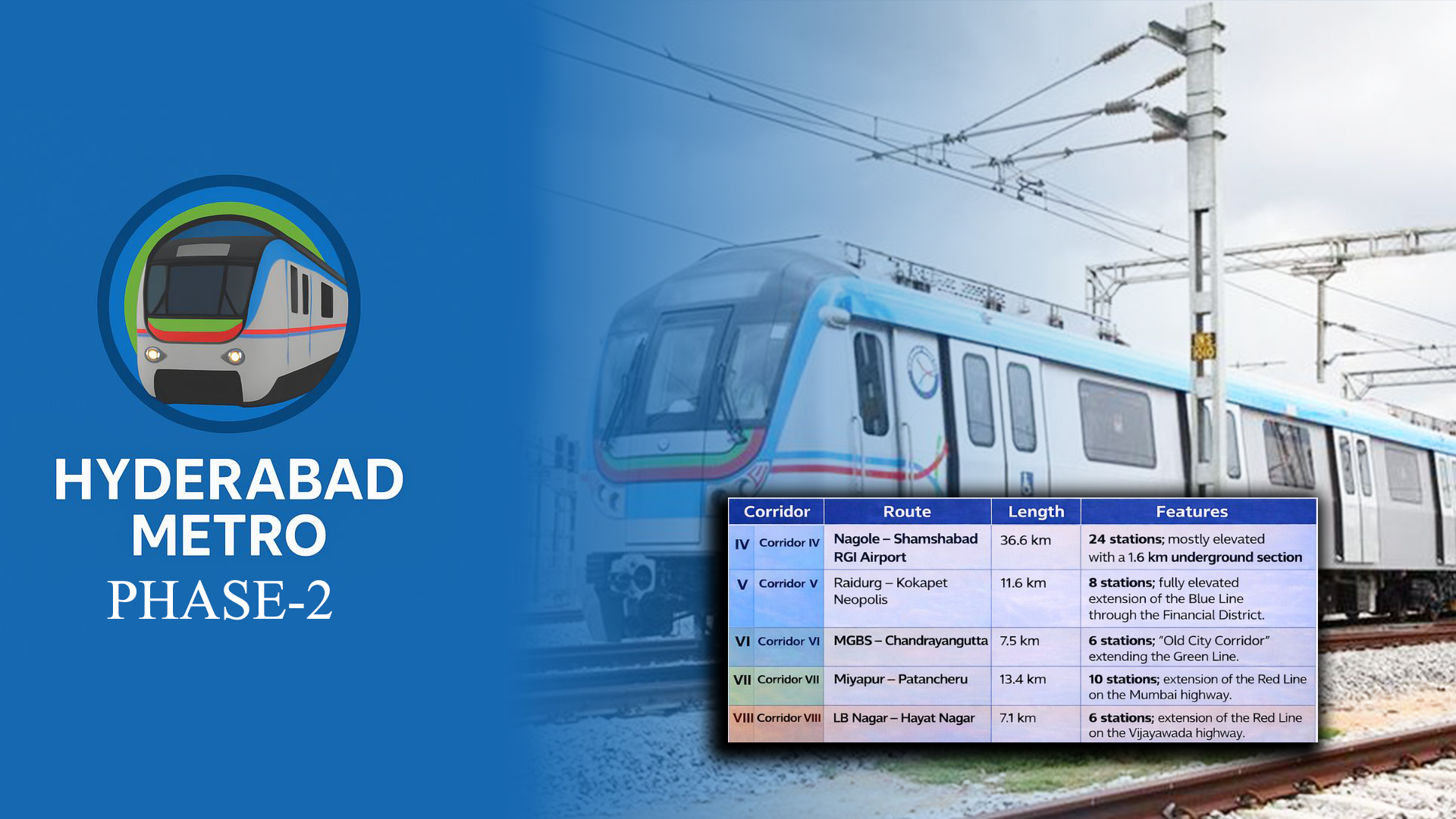
| Corridor | Route | Length | Key Features |
| IV | Nagole – Shamshabad RGI Airport | 36.6 km | 24 stations; mostly elevated with a 1.6 km underground section. |
| V | Raidurg – Kokapet Neopolis | 11.6 km | 8 stations; fully elevated extension of the Blue Line through the Financial District. |
| VI | MGBS – Chandrayangutta | 7.5 km | 6 stations; known as the “Old City Corridor” extending the Green Line. |
| VII | Miyapur – Patancheru | 13.4 km | 10 stations; extension of the Red Line on the Mumbai highway. |
| VIII | LB Nagar – Hayat Nagar | 7.1 km | 6 stations; extension of the Red Line on the Vijayawada highway. |
Exploring the Impact: A City Without Limits
Phase 2A isn’t just about adding mileage; it’s about solving the “Disconnected City” puzzle. By extending the Blue Line into Kokapet Neopolis and the Red Line toward Patancheru and Hayat Nagar, the metro is finally reaching the high-growth residential and industrial fringes that have long relied on congested highways.
The most vital artery is Corridor IV, which will finally link Nagole to the RGI Airport. With 24 stations and a strategic underground section, this route promises to make international travel a seamless experience for those living in the eastern and central parts of the city. Meanwhile, the Old City Corridor (Corridor VI) ensures that Hyderabad’s historical heart is integrated into its modern future, providing rapid transit to areas like Chandrayangutta.
As these corridors come to life, we can expect a significant reduction in carbon emissions and a surge in “Transit-Oriented Development,” where the station becomes the center of life, work, and play. Hyderabad is Always Big things. Impossible to everyone to achieve this.